Khon · Thai Culture & Performing ArtsClassical Khon mask-dance meets modern stagecraft. Cross-disciplinary unit with the arts team.
Sprout · Smart Permaculture & SensorsMicrocontrollers and moisture probes. Students built mini smart-farms that watered themselves.
the shades
How I'll remember it
A classroom full of you.
VERSO Middle Loop · Bangkok · 2024
Five years of these moments. The hands going up. The wrong answers that became right ones. The "oh wait, I get it now". I'll miss this very, very much.
Beat · Health & Data ScienceWearables, biometrics, and reading the body like a dataset.
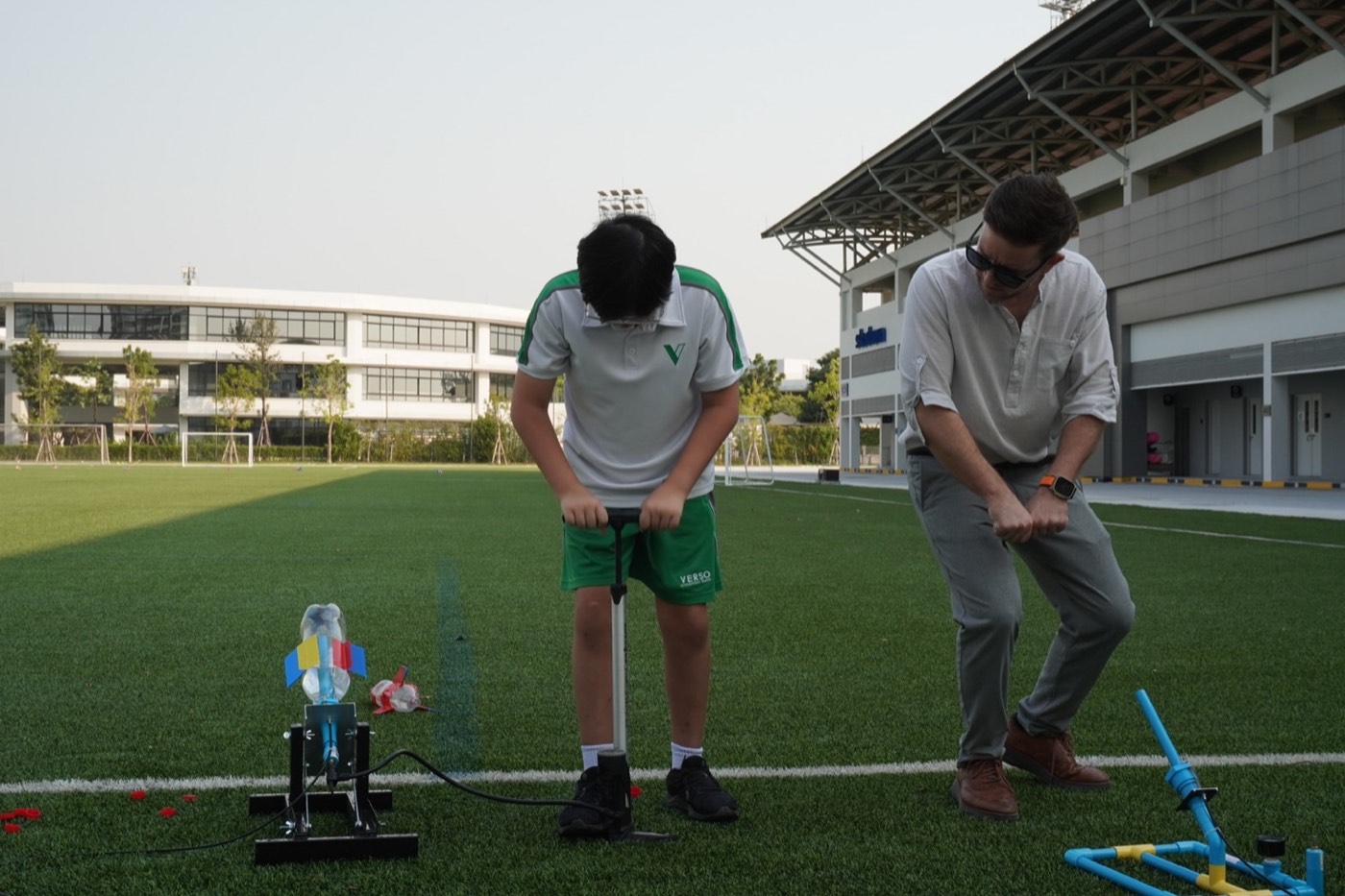
Splash · Water Rockets & Extreme EnvironmentsBottle rockets on the field, plus designing for the toughest conditions on Earth (and off it).
a lab mealworm
Penny · Financial Literacy & Business SimStudents ran simulated companies — pitched, pivoted, sometimes went bankrupt. All on purpose.
For the year ahead
Where are you headed?
Six pathways for the summer. Pick yours, work through the checklist, and copy the AI tutor prompt — paste it into ChatGPT, Claude, or Gemini and you'll have a tutor that already knows where you're going and what you need to learn.
Probability
Heads or tails?
H
0H · 0T · mean = —
Pick a pathway. Or flip for it.
US → UK
US Grade 5 / 6 → UK Year 6 / 7
Moving from the American system into a British school. The big shifts: SATs-style grammar terms, ratios and percentages earlier, and split sciences.
Open pathway
Grade 5/6 → IB MYP
Grade 5 / 6 → IB Middle Years (MYP 1)
Joining an IB school for MYP 1 (Year 7 equivalent). Concept-driven, inquiry-based, ATL skills, Global Contexts. The system shifts as much as the content does.
Open pathway
Grade 5/6 → American
Grade 5 / 6 → US 6th / 7th grade
Same system, new school. Common Core math and ELA, NGSS science. Ratio & proportion, longer essays, lab-based science — be ready, not ahead.
Open pathway
Y8 → Y9 · Pre-IGCSE
Grade 7 / Year 8 → Year 9
The final year before IGCSEs begin. This summer is the moment to get fluent in algebra, lock in scientific method, and start writing analytical essays.
Open pathway
Y9 → Y10 · IGCSE Year 1
Grade 8 / Year 9 → Year 10
IGCSE begins. Two years of work that ends in real external exams. Hit the ground running with the foundations every Year 10 teacher expects.
Open pathway
MYP · IB Middle Years
Joining or leaving MYP
The IB Middle Years Programme is concept-driven, inquiry-based and uses ATL skills. Whether you're moving in or moving out, here's how to bridge the gap.
Open pathway
Pathway 01
US Grade 5/6 → UK Year 6/7
The UK curriculum moves faster on some things and slower on others. By Year 6 you're expected to know grammar terms American schools don't teach (fronted adverbials, modal verbs, subordinate clauses), do long division and percentages confidently, and sit national tests (SATs). In Year 7 you start secondary school — sciences split into Biology, Chemistry, and Physics, and you'll use letters in algebra from week one.
Your summer checklist
Maths
English
Science
Where to revise
Khan Academy
Video + practice
Best for clear video explanations. Free, no account needed to watch.
Paste it as your first message. The AI will know what you're studying and how to teach you.
I'm a student moving from the American curriculum (Grade 5/6) into the British curriculum (Year 6/7). I have around 6 weeks of summer to bridge the gap before school starts.

The British system is ahead on a few things and uses different terminology, so I need help with:

MATHS — long division, fractions arithmetic, percentages of amounts, ratio and proportion, BIDMAS, negative numbers, area/perimeter of basic shapes, intro to algebra using letters.

ENGLISH — UK grammar terms (fronted adverbials, modal verbs, subordinate clauses, determiners), formal punctuation (semicolons, colons), and how to write in a formal register.

SCIENCE — basics of biology (classification, evolution), chemistry (states of matter, mixtures), and physics (circuits, forces). I want to be confident with "fair test" structure: variables, prediction, method, results.

Please be my tutor. Each session:
1. Ask which topic I want to work on.
2. Explain it at Year 6/7 level with one short example.
3. Give me 3 practice questions, one at a time, and check my work.
4. Tell me what to review tomorrow.

Start by asking me which subject I want to begin with and how confident I feel (1–5) in each area listed above.
Pathway 02
Grade 5/6 → IB Middle Years (MYP 1)
The IB Middle Years Programme starts at MYP 1 — roughly Year 7 / Grade 7 equivalent. Coming from any primary school, the biggest shift isn't the content. It's the how. You'll be asked to inquire, reflect, and write about why something matters, not just what it is. This summer is about both: solid subject foundations and the habits that make MYP students thrive.
Your summer checklist
Mathematics
Language & Literature (English)
Sciences (integrated)
IB habits (start now, save your future self)
Where to revise
Khan Academy
Concept-friendly video
Strong on the "why". Good fit for MYP inquiry style.
The AI will know you're entering MYP and will mix subject prep with IB habits.
I'm a student starting MYP 1 (IB Middle Years Programme) this September after finishing Grade 5/6. The IB system is concept-driven, inquiry-based, and graded on four criteria per subject, so I need to prep both subject content AND IB habits.

CONTENT — Maths: fluency with fractions/decimals/percentages, finding percentages of amounts, ratio & proportion, BIDMAS, area & perimeter, coordinates, intro to algebra (letters for unknowns). English: write a clear 5-paragraph essay, identify literary devices (simile, metaphor, personification), cite evidence with quotation marks. Sciences: "fair test" structure (variables, prediction, method, results), basic cell parts, states of matter, forces, simple circuits.

IB HABITS — quiz me on the 10 attributes of the IB Learner Profile until I can list them. Help me practice the 5 ATL skill clusters (Thinking, Communication, Social, Self-management, Research) with real-world examples. Teach me what "command terms" are (analyse, evaluate, describe, justify) and how each one expects a different kind of answer.

Each session:
1. Ask which subject and topic.
2. Diagnose with one short question.
3. Teach the gap with one worked example.
4. Give me 3 practice problems and mark them honestly.
5. End with a reflection prompt — what surprised me, what's still fuzzy.

Start by asking which subject I want first and how confident I feel (1–5) in each topic above. Be encouraging but honest — IB rewards thinking, not bluffing.
Pathway 03
Grade 5/6 → US 6th / 7th grade
Same system, new school. Most American schools follow Common Core for math and ELA, and NGSS for science, but expectations vary by district. The jump from 5th → 6th (or 6th → 7th) brings real new content: ratio and proportion, intro to negative numbers, longer essays with cited evidence, and more independent lab work. Aim to walk in ready, not ahead.
Your summer checklist
Math
English Language Arts
Science (NGSS-style)
Where to revise
Khan Academy
The American gold standard
Aligned to Common Core. Watch the videos, do the practice, get instant feedback.
Tell it which grade you're entering (6th or 7th) and it'll calibrate the depth.
I'm a student moving into 6th or 7th grade in an American school in September. Most US schools follow Common Core for math and ELA and NGSS for science. Help me get ready over the summer.

MATH — multi-digit multiplication and long division, fractions arithmetic, decimals (all four operations + word problems), percentages and conversions between fractions/decimals/percentages, ratio & proportion word problems (this is the BIG 6th grade topic), PEMDAS, coordinate plane in all four quadrants, intro to negative numbers, mean/median/mode/range.

ELA — write a 5-paragraph essay independently, cite evidence using quotation marks and page numbers, identify theme/plot/character/setting/point of view, spot common literary devices (simile, metaphor, personification, alliteration), and build a 30-word academic vocabulary list.

SCIENCE — the scientific method (hypothesis, variables, procedure, data, conclusion), how to write a lab report, animal vs plant cell parts, water cycle, carbon cycle, intro to Newton's laws, states of matter, basics of Earth's structure.

Please be my tutor:
1. Ask which subject and topic.
2. Diagnose with one quick question to see where I'm at.
3. Teach with one worked example.
4. Give me 3 practice problems and mark them honestly.
5. End with one tip for tomorrow's session.

Start by asking which subject I want first, whether I'm entering 6th or 7th grade, and my confidence (1–5) in each topic. Be encouraging but honest — I want to walk in ready, not embarrassed.
Pathway 04
Grade 7 / Year 8 → Year 9
Year 9 is the runway. IGCSEs start the year after, so this summer is where you turn shaky algebra into automatic algebra, learn to write a real analytical paragraph, and stop being scared of equations in science. Get this summer right and Year 10 feels easy. Get it wrong and you spend Year 10 catching up.
Your summer checklist
Maths
English
Sciences
Where to revise
Khan Academy
Video + practice
Strongest for maths and science explanations. Free.
The AI will know what level you're working at and what's coming next year.
I'm going into Year 9 of the British curriculum this September. Next year I start IGCSEs, so this summer I need to get really solid on the foundations.

MATHS — I need to be fluent in: simplifying/expanding/factorising algebra, solving linear and simultaneous equations, straight-line graphs (y = mx + c), Pythagoras' theorem, right-angle trigonometry (sin/cos/tan), index laws, standard form, basic probability, and finding mean/median/mode/range.

ENGLISH — I need to write good PEEL paragraphs (Point, Evidence, Explain, Link), analyse the *effect* of language techniques (not just name them), and feel comfortable with at least one Shakespeare play.

SCIENCE — Biology: cell structure, respiration & photosynthesis equations. Chemistry: atoms, the periodic table, balancing equations. Physics: speed-distance-time, Newton's three laws, energy stores and transfers.

Please be my tutor. Each session:
1. Ask me which subject and topic.
2. Diagnose with one quick question to see where I'm at.
3. Teach the bit I'm weakest on, with one worked example.
4. Give me 3 practice questions and mark them.
5. Tell me one thing to review before next session.

Start by asking which subject I want to begin with and how confident I am (1–5) in each topic above. Be encouraging but honest — I'd rather you tell me I'm wrong than let me drift into Year 10 thinking I'm fine.
Pathway 05
Grade 8 / Year 9 → Year 10 · IGCSE Year 1
IGCSE begins in September. Two years of work, then real external exams that universities and Sixth Forms will see. The single biggest predictor of a good IGCSE grade is how solid your Year 9 foundations are when you walk in. This summer, lock them in.
Staying at Wycombe?
You're on Edexcel — start with past papers.
Wycombe runs Pearson Edexcel International GCSE. The single most underrated revision tool is to look at a real past paper before you start studying — you see the style of question, the command words, and the way mark schemes reward (or punish) specific phrasings. Print one, try it cold, then revise the gaps it exposes.
The deepest archive — old papers going back decades, exam reports, examiner reports. Great for finding patterns and recurring topics.
Maths Genie · IGCSE
Maths only. Video solutions for every past paper question. If you're nervous about maths, start here.
edexcelpastpapers.com
No-frills paper dumps organised by year. Useful when you just want the PDF without browsing.
BBC Bitesize
Not past papers — but the best free explanations of concepts when a paper exposes a gap. Hit Bitesize, then go back to the paper.
💡 The play: grab the most recent Maths A paper, try it cold, mark yourself honestly, then use Save My Exams or PMT for the worked solutions on anything you missed. One paper a week from now till September and you walk into Year 10 already winning.
Replace [Cambridge / Edexcel] with your actual exam board when you know it.
I'm starting IGCSE Year 10 in September. My exam board is [Cambridge / Edexcel — replace with yours].

I need to be solid on the Year 9 foundations BEFORE September so I can hit Year 10 running. Help me revise:

MATHS — rearranging formulas, solving quadratics by factorising, solving inequalities, sketching quadratic/cubic/reciprocal curves, SOH CAH TOA both ways, basic circle theorems, vectors in column form, cumulative frequency and box plots, surds, fractional and negative indices.

ENGLISH — write a strong 4-paragraph PEEL essay in 45 minutes, analyse unseen poetry, do descriptive writing that shows rather than tells. I'll tell you which IGCSE set text my school uses.

SCIENCES — Biology: cells, enzymes, circulation, DNA, genetics. Chemistry: ionic/covalent/metallic bonding, moles, rates of reaction, equilibrium. Physics: Newton's laws, momentum, V = IR, waves.

Please be my tutor:
1. Each session, ask which subject and topic.
2. Give me one exam-style question first to diagnose where I am.
3. Teach the gap I show with one worked example.
4. Give me 3 more questions of rising difficulty.
5. End with one piece of advice for the next session.

Start by asking which subject I want first, my confidence (1–5) in each topic above, and whether I'm aiming for Foundation/Core (grades 1–5) or Higher/Extended (grades 4–9). Be honest with me — Year 10 doesn't reward bluffing.
Pathway 06
Joining or leaving the MYP
The IB Middle Years Programme is different. It's concept-driven instead of content-driven — you'll be asked "why" and "so what" before "what". It uses Approaches to Learning (ATL) skills, Global Contexts, and grades on four criteria per subject. Coming from a traditional curriculum or going back to one, the shift can feel disorientating until you know the language.
Two versions — pick the one that matches you and delete the other.
[IF JOINING MYP] I'm joining the IB Middle Years Programme this September. The MYP is concept-driven and uses inquiry, ATL skills, Global Contexts, and four assessment criteria per subject. Help me:

1. Internalise the IB Learner Profile (the 10 attributes) — quiz me until I can list them all from memory.
2. Practice the 5 ATL skill clusters (Thinking, Communication, Social, Self-management, Research) with a real-world example for each.
3. Walk me through the 6 Global Contexts with one statement-of-inquiry example per context.
4. Teach me to interpret command terms (analyse, evaluate, justify, describe) and how they map to MYP assessment criteria A, B, C, D.
5. Help me write reflective learning-journal entries — give me a prompt and feedback on what I write.

Ask me which subject I'll be strongest in so we can ground the examples there.

---

[IF LEAVING MYP, going into a traditional / IGCSE / AP / A-Level system] I'm leaving the IB MYP and entering a more content-driven, exam-based system. MYP rewarded reflection and process; my new curriculum rewards retrieval and timed answers. Help me:

1. Drill subject vocabulary — give me flashcards and quiz me until I'm fluent.
2. Practice timed essay questions (45 min, no prep) and grade me on a real mark scheme.
3. Build a 6-week study plan that switches my study habits from "process" to "retrieval".
4. Run past paper questions on demand and give me model answers afterwards.
5. Spot where my MYP training is hurting me — e.g. too much reflection where the mark scheme wants definitions.

Start by asking which subjects I'm taking, what curriculum I'm moving into (IGCSE, A-Level, AP, national exam), and whether I have any past papers I can share.
Neuro · Neuropsychology & Growth MindsetHow the brain learns, and how to grow one. The science of effort.
One more thing
Whatever curriculum you walk into, whatever room you sit in next year — remember this. The work you put in this summer is invisible to everyone but you. That's the point. The student who shows up in September already fluent isn't lucky. They were quietly relentless when no one was watching.
Be that student.
Maths
The shape of effort
y = 2.5 sin(2.0 x)
Tall and slow, or short and frequent — pick your kind of progress.
Woof!
0 pets
Mic · Voices of Change PodcastStudents wrote, recorded and edited a podcast on issues that mattered to them. Released it publicly.
Terra · Designing for New Planet EnvironmentsWhat would you build on Mars? Sealed habitats, sustainable cycles, and a flag for the trip home.
If you ever miss me
Talk to AI Mr. Dex.
I built an AI version of myself on Flint K-12 — trained on how I teach, the way I explain things, and a lot of how I'd answer if you put your hand up in class. He's not perfect. But he's me-shaped. And he doesn't sleep.
d
An adaptive tutor that knows my voice.
Stuck on a question? Need a concept explained one more time? Lost your notes the night before a test? Open AI Mr. Dex. He'll work through it with you the same way I would — patient, a little sarcastic, and never, ever just hand you the answer.
⚠️ Not actually me. I haven't gained consciousness in a server yet. He's an AI trained to teach the way I do — close, but he sometimes hallucinates. If anything sounds wrong, check it. And email the real me if it really matters: dex.d@dexstem.com.
Computer Science
How AI Mr. Dex thinks
0
8
0
4
0
2
0
1
= 0
Underneath, it's all just ones and zeros. Click to flip a bit.
You · 22:47
i don't understand simultaneous equations help
AI Mr. Dex · 22:47
Right — deep breath. Two equations, two unknowns. We're going to *get rid* of one variable so the other becomes obvious. Write them down for me and I'll walk you through it. Or, do you remember what "elimination" means? Tell me what comes to mind first.
You · 22:48
like… adding them together to cancel something?
AI Mr. Dex · 22:48
Exactly that. Good instinct. Show me both equations and we'll find which variable we can cancel first. (See? You already half-knew.)
Kai · TCDF Child Development FoundationOutreach with the Thai Children & Youth Foundation. Reading workshops, donation drives, real heart.
Stilt · Flood-Resilience Social EnterpriseDesigning homes for a Thailand that floods. Students pitched real social-enterprise ideas.
For the parents
Thank you for trusting me with them.
Five years of pick-ups, conversos, showtimes, and late-night emails about half-finished projects. None of what your children achieved was possible without you behind them.
If you'd like to grab a coffee, talk shop, or sound out an idea — I'd love that. I'm officially unemployed for the next year and will mostly be on a beach drinking coconuts. But the phone's on.
🥥 Available for coffee, consulting, and conversation
Engineering
The hello robot
0 high-fives
Click to wave. Every third high-five he hops.
your treat
Say hi.
Coffee, a quick call, a wild business idea — all welcome.
Sprocket Jr. · Junior Engineer's JourneyStarter unit on tools, safety, and "what does this lever do?"
on holiday already
A quick introduction
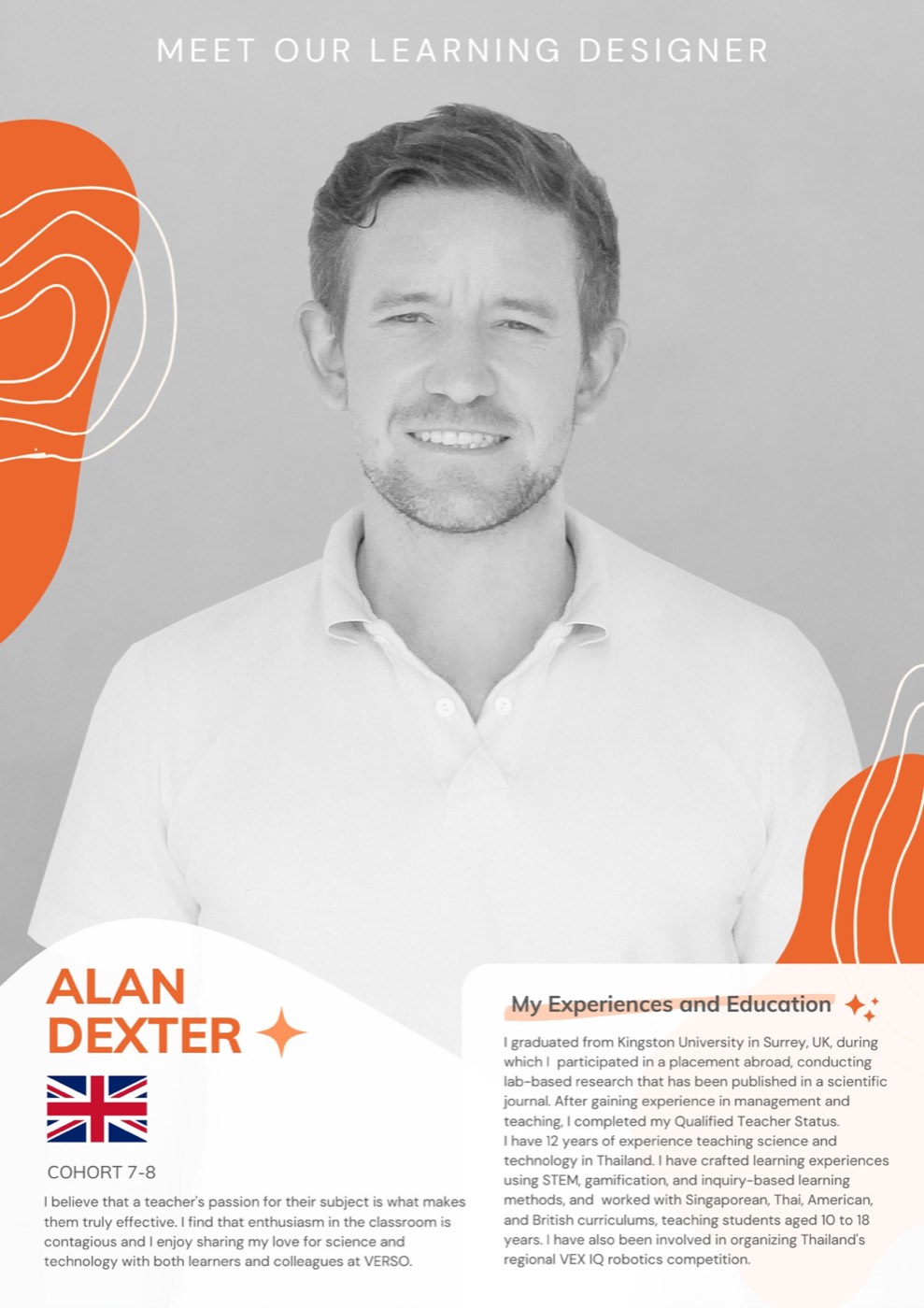
Hi, I'm Dex.
I'm a serial entrepreneur and a polymath of the self-taught kind. I've been in Thailand for years and am currently working through the Thai citizenship process — anyone who's tried it will tell you it's a journey.
By training I'm a STEM teacher: physics, chemistry, biology, maths. By temperament I pick up a new discipline roughly every 18 months. So far that's included laser cutting · 3D printing · web design & development · product design · smart-home automation · investment & real-estate · AI tooling for hospitality and education.
These days I split my time between a 1950s heritage shophouse in Yaowarat that we restored room by room, a poker-timer SaaS that quietly runs home games around the world, a smart-lock platform for short-term rentals, and a science-simulation platform for the next generation of curious kids. None of it would be possible without a very patient partner and an outrageous amount of black coffee.
The through-line: I like problems that sit halfway between fix something practical and build something beautiful. Fourteen years of teaching taught me that the best ideas come from people paying very close attention. I'm taking that into whatever's next.
🇹🇭 Bangkok-based🥥 Currently semi-retired (until I'm not)📩 dex.d@dexstem.com
Bolt · VEX Robotics & EngineeringCompetition robots, tracks and claws. Years of after-school builds and tournament Saturdays.
a beetle
A peek inside
The workshop
A few things currently on the bench. Hover for the name, tap to jump to the details below.
Click anything
Chemistry
The thinking beaker
Tip in acid or base. Watch the colour shift.
What I'm building
A few things I've been working on
If any of these are interesting — as a customer, an investor, a collaborator, or just out of curiosity — the door is open.
It'll land in my inbox within a minute. I'll reply when the coconuts allow.
Zipp · Mobility Innovation ProjectStudents designed mobility aids — assistive devices for people with mobility impairments. Real users, real briefs.
Newton · Balloon CarsPneumatic race-cars on a flat track. F = ma, the long way around.
A project we built together
Mobility Innovation Project
Engineering · Design Thinking · Technology
A High School STEM Design Challenge where students designed mobility aids — assistive devices for people who live with mobility impairments. Each team started with a real user in mind and worked back from there.
The point wasn't to build something flashy. It was to build something useful: imagine for a real person, prototype, test it, refine. The thing the textbook calls iteration and real engineers call Tuesday.
Key learning areas
Mechanics & motion principles
Design-thinking methodology
Iterative prototyping
Testing & refinement
User-centred design
Your turn
Pump it. Launch it. See how far it goes.
Tap pump to build pressure. Hit launch when you're ready. Then tell me how far you sent it.
Pressure
0 PSI
0 m—
tap RESET to try again
0 pumps so far · personal best: 0 m
🏆
Hall of fame
The all-time longest rocket launches from anyone who's ever read this page.
Loading leaderboard…
Just launched 0 m. Save your score?
✨ The animals see you ✨
↑↑↓↓←→←→BA · easter egg unlocked
🚀 0% fueled
Mr. Dex's farewell trick
I'm going to read your mind.
One last gift before I disappear into the coconuts. Stay with me.
Step 1 of 5
Pick any number between 1 and 10.
?
Don't tell me. Just hold it in your head.
Step 2 of 5
Multiply your number by 2.
× 2
Step 3 of 5
Now add 8.
+ 8
Step 4 of 5
Divide by 2.
÷ 2
Step 5 of 5
Now subtract the number you started with.
− your number
Got your final answer? Hold it in your head.
Concentrate.
Tuning in to your frequency…
Your final answer is…
4
Was I right?
Naturally.
The coconut's on you.
One real coconut from the cart down the road = 50 ฿. Any amount welcome — I'll think of you on the beach.
QR coming soon
Drop your PromptPay QR at /photos/promptpay-qr.jpg
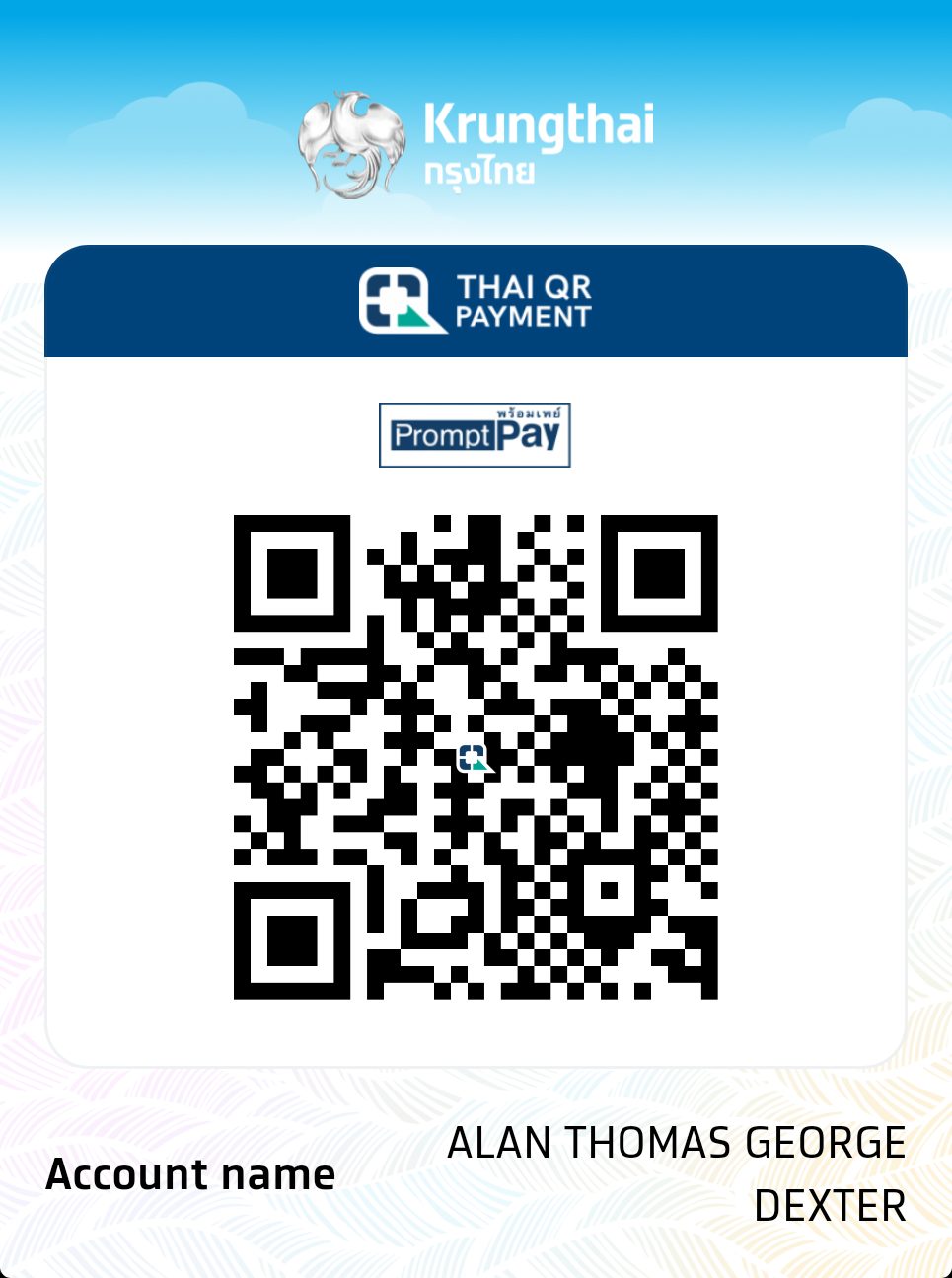
PromptPay · scan with any Thai banking app Recipient: Alan Thomas George Dexter · Krungthai
ขอบคุณนะครับ — Mr. Dex
Hmm.
I lost my touch for one round in ten years. Or you fibbed. Either way — want another shot?